
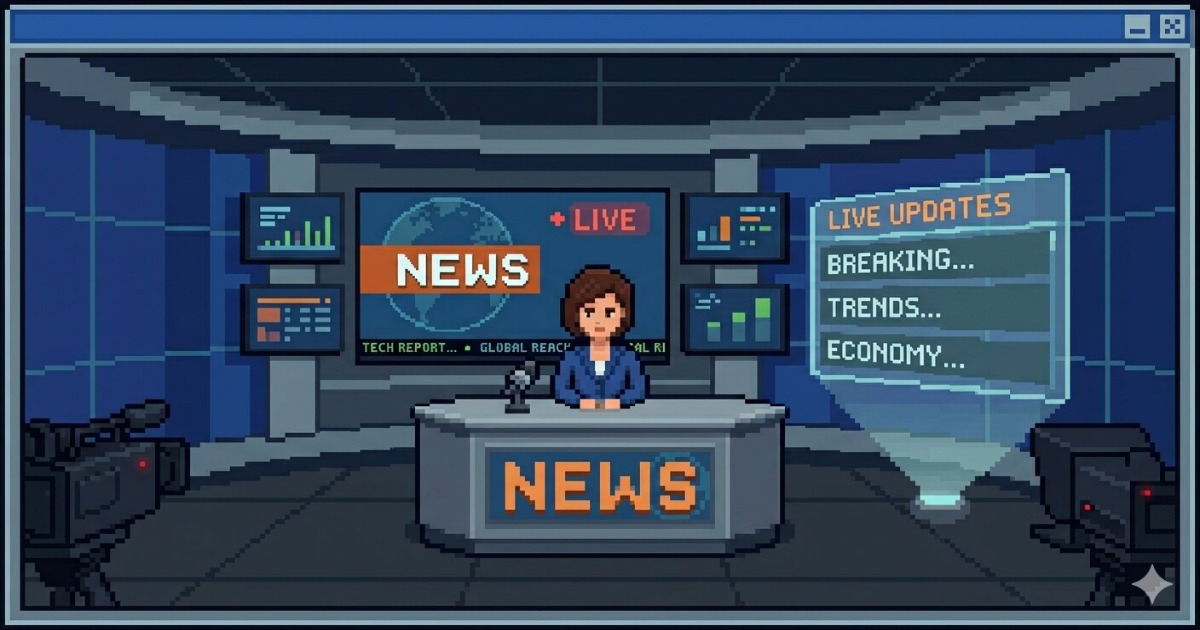
To get virtual sets in the journalism world clearly, I will take you to the traditional days when things were not based on the projector screen; rather, they were on a blackboard where every teacher used to write on that with chalk and explain everything verbally, but each student had a notebook to write in, parallel, and a book for reading as a reference.
As technology upgraded with time, things were changing constantly. Following the changes, they reached for whiteboards to teach using a marker. Chasing the advancement of things, they came to the projector for a reading reference and audio lecture in place of a teaching individual. Now, we are proceeding towards robotics.
A Step Towards Virtual Sets in the Journalism World
In journalism, virtual set work is recognized as a digital stage. From ancient times, we know that newsrooms used to be prepared with wooden desks and physical plastic materials. These days we see a kind of virtual set in the journalism world everywhere in place of a physical recording studio. The entire system is based on robotics. These days, the artificial news anchors are overtaking the real individuals who read news compared to the front view.
The background of the newsroom is based on AI. They use the empty space with a green background where they record a formal video, and then, using the AI, they express that the anchor or reporter is standing in a proper studio as they are covering news from a real spot. But on the television screen of your home, it will seem that the news is getting broadcast from an actual location. It distracts the person watching news over the television.
The Magic of Virtual sets in the Journalism World: From Green Screens to LED Volumes
The magic of virtual sets in the journalism world comes from the ability to break the limits of a real studio. These days, newsrooms are transforming to “limitless stages” where anchors not only report the news but also inhabit it. Using immediate 3D engines, a little corner of a room can be transformed into a large virtual set or a digital reconstruction of a warming zone.
This technology transforms mathematical data into 3D visuals that rise from the ground, making lengthy stories accessible and entertaining. Behind the visual showpiece, the magic is useful, removing the need for major real structures while providing a chance to modify an entire visual connection’s look with a single click. It transforms broadcasting into an exciting, social experience that engages viewers in an age of constant online diversion.
- Green Screen: Green Screen is the traditional approach in which everything beyond the reporter is bright green. A computer turns out a shade of green, replacing it with a virtual set in the journalism world.
By documenting, a reporter against a vibrant green background can remove the unique shade and replace it using any digital visual of a virtual set in the journalism world. This makes an average local station appear like a worldwide news empire by putting anchors in front of fake structures or advanced command rooms.
It is critical for weather forecasters to point toward a green wall while looking at an LCD screen that displays a digital map behind them. Although newer LED solutions are developing, the green screen maintains a journalism standard because it is easily flexible and enables newsrooms to transform their entire visual identity in seconds without using any tool.
- LED Volumes: This is the latest and enhanced version. Utilizing green screen, the walls are covered with massive, sharp TV displays. The digital environment is present in the space with the reporter, generating true light and effects.
The power of LED volumes is their capacity to bring “the field” into the studio. Unlike typical green screens, LED volumes employ vast, high-quality screens that ring around the anchor and display incredible 3D worlds. For journalists, this is a game changer since the screens generate realistic light and reflections, letting the anchor appear to be standing in a sunny city square or a scary forest at night.
There is no “green overflow” or blurred edges; the lighting is excellent and beautiful. This “in-camera” realism allows reporters to view the digital world they are explaining, resulting in more natural, engaging displays that blur the distinction between the recording facility and the actual story.
Camera Tracking: Background Rotation of Virtual Sets in Journalism
Camera Tracking is the undetectable engine that gives a virtual sense of a physical reality. In typical setups, if the camera moves, the background stays flat and frozen, instantly eliminating the effect. However, with powerful tracking sensors, the computer can determine the camera’s actual spot, angle, and wavelength appropriately. As the camera spins or revolves, the digital background moves and rotates in exact rhythm.
This produces a lateral effect in which elements in the front row move quicker than things in the background, much as they behave in the actual environment. For the user, it indicates that the virtual office has depth sense. Whenever the camera focuses in on a reporter or revolves around a 3D data model, the viewpoint is outstanding, making the viewer forget they are watching a computer recreation.
- Data Visualization
Data visualization is the practice of transforming complex numbers into clear, visual narratives. Journalists explain basic statistics using 3D charts, interactive maps, and virtual reality images. In virtual settings of the journalism world, these graphics jump off the screen, letting anchors to navigate around data instead of simply delivering it.
- The Benefits
Virtual sets provide a “limitless design” that traditional studios can’t cover. Developing a major setup in typical media requires weeks of construction, expensive materials, and physical storage space. In a virtual environment, a designer can quickly develop a huge, three-story glass newsroom or a future space station.
This “limitless design” enables a single small studio to stage ten different performances, each with its covers different style, without changing a single piece of furnishings.
- Versatility– Virtual sets have limitless flexibility, letting a single tiny studio to quickly convert from a warm morning talk show to a large, multi-story worldwide newsroom.
- Cost– Virtual sets save money by eliminating physical manufacture, storage, and travel. One studio can accommodate numerous high-end concerts each day, making the most of available space and personnel resources.
Conclusion
Virtual sets in the journalism world are moving from visionary novelty to business norm. By combining the physical and digital themes, journalism has evolved into more interactive, cost-effective, and visual narratives. As technology advances, these digital stages will ensure that news stays useful and flexible in a constantly shifting media ecosystem.
This gave me a whole new perspective. Thanks for opening my eyes.
Great article! I’ve been using Claude Fable 5 () for similar projects. Claude Fable 5
Sprunki’s business model supports sustainable development.