
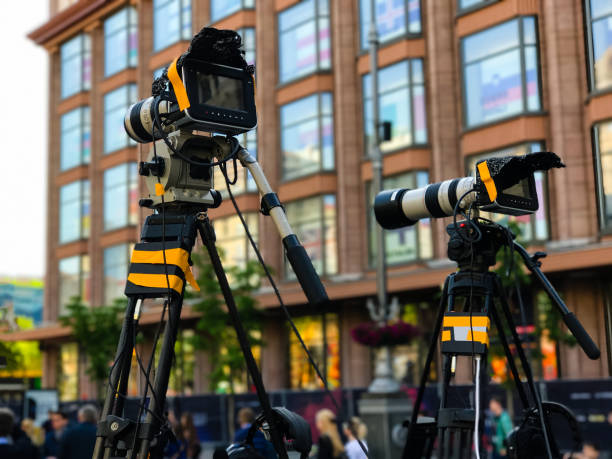
PTCs are an important part of reporting in media. PTC means “piece to cameras,” i.e., a small part in front of the camera that is understandable only by name, but in reality its importance is special; when we are showing a report on TV, then piece to camera is significant.
Standing in front of the camera and talking about the incident or anything related to that issue means we come in front of the camera for about twenty to forty seconds, and during this time we talk about some things related to the same incident or issue. Whatever is important, we tell it to our audience; we call it piece to camera.
Types of PTCs and How to Bring Them into action
There are many types of piece to camera, of which the basic PTCs are three. As explained in the beginning, sometimes we give footage while talking with someone, sometimes we give proper piece to camera while standing by, so these are different patterns of the same process Walking a few steps during the piece to camera is also included, as it’s an important part.
For example, in the beginning, we come on the screen and start giving the report, “As we know, many incidents take place at different places in our nation; to handle the situation, we take various statements. In such a situation, how much work the politicians have done on this, we can get from the events happening in the country.
Now see how we have used some heavy words in a good medium by converting the words a little so that our PTC looks more impressive. We told people like this for a long twenty to thirty seconds that we can see what the general public has to say on the issue of “XYZ”; let us show you in this report.
After that, the report is screened again; if we are available at the spot, we coordinate with people, and we present in the walk-through. After that the visuals run over the screen, and others’ bytes get played. So, in the beginning we do a piece to camera, i.e., we start it as an opening PTC.
Now, our entire report is completed. We again come in the middle; that is, it has become Mid-PTC, that is, in the middle, clarified from the name itself, as you saw it in the XYZ case. Now, we have to see what new twist comes in this matter.
So if the people present there bite, they have said something, and we can narrate them on this issue or tell ourselves that is what the people here say. We present a little information based on that incident, which was very big; we call it Mid PTC. After that we reach the conclusion, which we tell in the last, that is, the closing PTC. Using this, we convey the main essence of the entire story to the audience.
We presented the piece to the camera, played some visuals, and included VO on it; some bytes will run, or bumpers will be played. Many things run in the format of news. After that, we play the final PTC, which is called closing. While closing PTC, we will have to keep some more things in mind. In this, at last, we have to mention our name, the name of our channel, the name of our video journalist who is with us on camera, and from where we are doing PTCs.
Detailed PTCs Information We Should know
While doing the closing piece to camera, we will have to keep some other things in mind. If we are reporting from XYZ, we will say that, and finally, we have to say that with the cameraman’s name. This is the complete format of closing PTC, i.e., ending. So piece to camera is very important. Reporters always present PTC. There is no work for PTC anchors, especially not for those who are new. The anchor never does PTC; the anchor will only read the link, and after that, the reporter will present the complete report and stories about the news.
The report has been sent to the audience by the reporter; it has been prepared, or if our reporter is present on the spot, then he can tell us that he gave the entire report along with the cameraman. Many times there is no mid-PTC; there is only an opening PTC and a closing PTC. Sometimes there is only a closing PTC and not even an opening.
It depends on the reporter. If the reporter does not give a piece to the camera, then the news anchor has to leave a question along with the visuals. Like “it remains to be seen what happens next in this matter.” So the story will have to be ended with a question mark so that the audience remains engaged and feels quite connected.
PTCs 4 Major Tips During News Reporting
Why PTC is important for a reporter should also be discussed. The main objective of a reporter is to be visible to the audience.
- Somewhere the anchor is seen on TV, and the reporter is also seen on TV delivering the news. So how much more is the reporter visible while delivering the news? As if we could not be seen from behind in the photo. We are visible during live, but we are also visible in PTCs. So there is a story in it, we have made it, we have covered it, we are visible, and we are talking to people, so this is a big thing for the reporter.
- If we ever go for reporting, then we will be seen on the screen, and we will not like anything more than this. We do the opening PTC, mid-PTC, and closing PTC. If closing is not done, then the script written by the anchor and reporter is recited in the last VO; we call it closing. In closing, many times we forget; in such a situation we just say, “All eyes are on when this will happen. To know, stay connected with us and keep watching our channel.” After that the screen cut.
- In closing, many times we forget to mention the name. In such a situation, if we do not give a piece to the camera, then it is written from the office that our reporter’s report is from the our channel. Whoever has presented the report, we write it. If there is any program or any such topic that has not been reported by anyone or we have prepared that report on the desk, then the news desk, ABC News, ends it like this.
- Therefore, PTCs play an important role. While doing a piece to camera, we should keep these things in mind. Take care of our body language. Especially be careful about our dressing sense. Our reporters have a different kind of dressing sense. We don’t go wearing make-up like anchors. Because we are on the field, of course, we don’t need that much makeup.
Conclusion
In journalism, PTCs are considered the soul of news reporting. When the audience watches the news channel on their television screen, they are keen to stay updated with the entire story of the news. The PTC is the medium of their news source, and we are responsible for making it possible. So while doing PTC, our reporters should look good and natural because they are expressing the facts from the ground.
But in the studio, we are in a completely soundproof room; it is a little black. In a way, we can say there is a lot of light, but according to the camera, we need light, and we need make-up.